Categories
Uncategorized

Morning Boost – Weekly Stand #1

Bystander Revolution has a great way to keep the conversation going about creating a bystander revolution and changing lives around us for the better. Here’s what they say about the weekly stand:

“What is it?
 
The Weekly Stand is a low-commitment, high-impact initiative for anyone who wants to take the power out of bullying. We’ve created 52 fun, simple, transformative actions packed with helpful background information, tips to consider, and phrases to try.
 
How does it work?
 
Do the actions from start to finish, or do them in any order you want! Just pick at least one to complete every week until you’ve done them all. Our hope is that if enough people join in, we can start to shift the culture – for good.”
 

Here’s week #1

Starting the day with a positive mindset can impact everything else that follows. In fact, how you feel in the morning can set the tone for the rest of the day. Help your friends get off on the right foot by texting something positive to a different person first thing every morning this week. You could say, “Hey! Just wanted to let you know how much you mean to me. I don’t think I say it enough,” or “Here’s a random reminder that you’re AWESOME and you’re gonna crush it today!” Just think about what you would want to hear if you were them, type, and send!

Categories
Uncategorized

The Bystander Effect

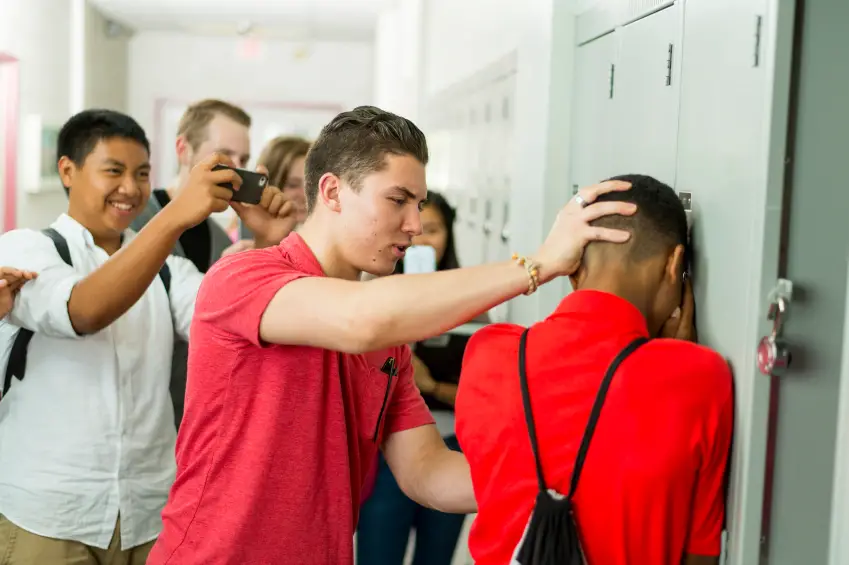
Image result for bulliesYou may know that I take a special interest in making schools safe for all kids, and especially safe from bullying and abuse. I experienced it when I was younger. So I can relate. That’s why I’m not totally comfortable with an anti-bullying approach to the issue. I think it more important to focus on what we want, not what we don’t want.

Strategies that focus only on condemning the bully and teaching kids to report their abuse to a teacher or other responsible adult miss the point. That approach makes it the responsibility of the person being abused to fix it. I was told that. And all it did was make me feel more alone than ever.

I say we all have a responsibility. And here’s the message I want to send to students:  “Each and every one of you is responsible for the environment and culture you live in.”

When you are a bystander of abusive behavior, you become a part of it. When we stand together as a community and say “that is not behavior we accept,” no one accuses the bully (who is really just another student with issues), but instead, we articulate a standard we hold everyone to.

Recently I discovered a tremendous resource for explaining much better than I the importance of rejecting bystander behavior. It’s so important that each week, I intend to post a new video about how to overcome inaction and create a bystander revolution.

Ever feel yourself hesitate to help when someone is being mistreated? Insights on what is going on from a famous psychologist and founder of the Heroic Imagination Project.

Simple acts of kindness, courage, and inclusion anyone can use to take the power out of bullying.

Categories
Uncategorized

Appreciate your Teachers Today!

Image result for teacher appreciation dayOde to Teachers

I remember
the first day,
how I looked down,
hoping you wouldn’t see
me,
and when I glanced up,
I saw your smile
shining like a soft light
from deep inside you.
“I’m listening,” you encourage us.
“Come on!
Join our conversation,
let us hear your neon certainties,
thorny doubts, tangled angers,”
but for weeks I hid inside.
I read and reread your notes
praising
my writing,
and you whispered,
“We need you
and your stories
and questions
that like a fresh path
will take us to new vistas.”
Slowly, your faith grew
into my courage
and for you—
instead of handing you
a note or apple or flowers—
I raised my hand.
I carry your smile
and faith inside like I carry
my dog’s face,
my sister’s laugh,
creamy melodies,
the softness of sunrise,
steady blessings of stars,
autumn smell of gingerbread,
the security of a sweater on a chilly day.
Pat Mora, “Ode To Teachers” from Dizzy in Your Eyes. Copyright © 2010 by Pat Mora. Used by permission of Alfred A. Knopf, an imprint of Random House Children’s Books, a division of Penguin Random House LLC. All Rights Reserved.
Source: Dizzy in Your Eyes (Alfred A. Knopf, 2010)
https://www.poetryfoundation.org/poems/58830/ode-to-teachers
Categories
Uncategorized

6 is Moving!

Image result for six movingAfter years of discussion and study, the OUSD Board of Education unanimously voted last night to move the OUSD 6th graders from our elementary schools to Matilija in Fall of 2019, creating a true middle school from our current junior high school.

At a special meeting held at Matilija Auditorium (link to the meeting video here – be patient, the meeting doesn’t start until about 26 minutes into the video), the Board listened to parents and teachers sharing their concerns, fears, and hopes for this change. This change was considered in 2014 but rejected due to potential costs. It was discussed as far back as 2009 in recent memory.

I heard from many parents over the last few weeks as word of this possible change spread. Most were nervous about their 6th graders leaving the supportive elementary school environment.

As I explained last night, my first reaction to this question was to ask “why?” Change of any kind is difficult and can be disruptive, and for kids its even tougher. So I felt that there needed to be a good reason to make a change.

Image result for middle school

Thankfully, we have great teachers in the OUSD who took the time and effort to thoroughly research the field and present us with very good information about a possible change.

There are essentially three reasons why I support this change now:

  1. Today’s curriculum is designed for a grade 6 through 8 progression. That means that 6th grade teachers at the elementary schools are using totally different curriculum than the other teachers, curriculum that is designed to mesh with grades 7 and 8. As one 6th grade teacher said last night, “I’m on my own at my school. I have no one to collaborate with.” Combining 6th grade into a middle school actually enhances teachers’ ability to teach.
  2. Enrollment losses threaten the vitality of programs at Matilija. We only have one junior high school, and lower enrollment could mean cancelling programs and offerings. A thinner school would impact all our students eventually, and could hinder their preparation for college later.
  3. Creating a middle school model gives us a chance to reinvent Matilija using all the latest research and best practices. A middle school is not a high school. They are different models, approaching education from different angles. I really like the descriptions of a true contemporary middle school model. Student-centered, experiential, I think these are virtues that will help 6th graders make the transition, and benefit 7 and 8 as well. And its not a new model. Most districts in the county and the state are predominantly middle school (grades 6-8) districts.

Related imageIt’s not a slam dunk change.

There are aspects that need special attention. I’m gratified that our teachers and administrators listened to the concerns expressed and came up with preliminary ideas to address these very real and important concerns. Its important to say that there are no solid answers to all the questions yet. Those answers must be developed in collaboration with parents, students, administrators, and teachers. The board made it clear that they expect widespread participation in the transition planning, and that we will be watching to make sure.

  1. Junior high school is too unstructured for 6th graders compared to the elementary school. We discussed how block scheduling and a daily advisory period, among other things, can assist 6th graders to transition from very structured to less structured school days.Another concern was the change from a single teacher all day to multiple teachers, and the accompanying loss of connection and stability. With block scheduling, the number of teachers a 6th grader experiences are minimized. The advisory period teacher can form a daily  bond with the students and function as a connection point between the student and other teachers. No one suggested just throwing the kids into the middle school pool. There is solid recognition that we will need to design and implement an effective transition strategy for 6th graders.
  2. 6th graders are too young to expose to the more mature 7th and 8th graders. Many parents shared their concerns that 7th and 8th graders are too mature and advanced to have next to 6th graders. Our teachers have considered this as well. Suggestions and ideas included clustering 6th grade classes and possibly staggering lunch periods.
  3. 6th graders are simply too immature for the independence of a middle school. True that, but they will inevitably have to learn. The modern middle school model recognizes that our teaching mission is both academic and developmental for 6th graders (“Emphasis is on both cognitive and affective development.”) A true modern middle school works on both thinking and feeling maturity and skills. In fact, as we discussed the  benefits of the new model for 6th graders, many in the audience expressed the hope that school administrators will expand this approach to the entire middle school…an idea that our teachers and administrators endorsed.
  4. 6th graders will miss out on key experiences like the CIMI trip. It is true that various programs for 6th graders will need to be evaluated. Special handling will be required for the first group of 6th graders making the change, and all our administrators know this. They are committed to assuring that no student loses access to experiences as a result of this change. To that end, they will be meeting early and often with school parent organizations to map out the future.

I know this change will unnerve many parents. As one of five board members, I can confidently say that my colleagues on the board join me in assuring our parents and community that this transition will :

  • be carefully planned (we have more than a year before implementation);
  • involve parents at every stage at every school;
  • prioritize students and educational benefits over all else.

It’s an exciting change, and I hope that you will join us for one of the most important academic opportunities this district has seen in years. Let’s work together to build a school district of the 21st century, rooted in old-fashioned values.

Image result for middle school

Comparison Chart

Middle School Junior High School
Middle schools are more about students Junior high schools are more about the subjects that are being taught
Middle school teachers focus on combined development and educational needs of students, combining two lessons for better understanding Teachers at junior high teach specific subjects all day and the students have to attend those specific classes
Middle school helps students in their social, organizational as well as personality development skills Junior high helps students with cognitive, memory development and information processing skills
Middle school has younger students that include grades 6 and 7 or even 8 Junior high school has older students as it includes grades 7, 8 and even 9 and prepares for transition to high school
Categories
Uncategorized

Citizens Oversight Committee Meeting

Image result for meeting4-24-18 Citizens’ Oversight Committee Agenda 

The meeting will begin at 5:30 PM in the District Office Board Room.


Categories
Uncategorized

Ventura College Coach Wins Award

Cowen Named NACDA Under Armour JC/CC AD of the YearThe National Association of Collegiate Directors of Athletics (NACDA) announced the 28 winners of the Under Armour AD of the Year Award (ADOY) today. The award spans seven divisions (NCAA FBS, FCS, Division I-AAA, II, III, NAIA/Other Four-Year Institutions and Junior College/Community Colleges). Ventura College Athletic Director Will Cowen was named as one of the recipients of this prestigious national award.

Congratulations Will!

Our local community colleges are a local treasure for our students. Cost-effective, academically sound programs leading to a degree or transfer to a four-year college or university without crushing debt.

Categories
Uncategorized

Requiem

Teachers and coaches dedicate their lives to students. Occasionally, tragically, they give their lives. Appreciate them, cherish them. They are the last line of protection for our kids when the unthinkable happens.

Categories
Uncategorized

Ventura College Publishes Financial Aid Newsletter

financial aidThe Ventura College Financial Aid Office has published the Spring 2018 Newsletter. Topics include: Dreamers Set Your Course events, upcoming Cash for College workshops, CalFresh information and Meet our New Staff. 

This version of the newsletter is interactive. Try clicking on different pictures and links to be taken to our website for forms, articles, and more helpful information!

Spring 2018 Financial Aid Newsletter (Best viewed using Chrome or Internet Explorer)

View previous editions of the Financial Aid Office Newsletter by clicking here.


Categories
Uncategorized

Get a Bowl and Help Nordhoff!

bowl

Categories
Uncategorized

Ventura College Named one of the Nation’s Top Community Colleges

2018 01.26 VC Aspen Prize Finalist Press Release FINAL(VENTURA, Calif.) Jan. 26, 2018 – The Aspen Institute College Excellence Program named Ventura College one of the nation’s top 150 community colleges eligible to compete for the 2019 Aspen Prize for Community College Excellence. The prize includes $1 million dollars in prize funds, as well as Siemens Technical Scholars Program student scholarships, highlighting the critical importance of improving student success in America’s community colleges.

The Prize, awarded every two years, is the nation’s signature recognition of high achievement and performance among America’s community colleges. The Aspen Prize recognizes institutions for exceptional student outcomes in four areas: student learning, certificate and degree completion, employment and earnings, and access and success for minority and low-income students. Ventura was also awarded the nomination honor for the 2017 award.

“I am grateful for the dedicated work of all our college employees,” said President David Keebler. “Their efforts directly help students succeed at Ventura College. It is very exciting to receive this recognition from the Aspen Institute and we look forward to completing our application for the 2019 award.”

Ventura College is one of 16 California Community Colleges eligible for the prize. A full list of the selected colleges and details on the selection process are available at www.aspenprize.org.

Ventura College is invited to submit an application to the Aspen Prize for Community College Excellence containing detailed data on degree and certificate completion (including progress and transfer rates), labor market outcomes (employment and earnings), and student learning outcomes. The Aspen Institute will select ten finalists, from the 150 eligible nominations, to be named in fall 2018. The Aspen Institute will then conduct site visits to each of the finalists and collect additional quantitative data. A distinguished Prize Jury will select a grand prize winner and a few finalists with distinction in early 2019.

About Ventura College: Ventura College, an accredited two-year institution of higher education, has been a part of the beautiful seaside community of Ventura, California, since 1925. It is conveniently located approximately 60 miles north of Los Angeles and 30 miles south of Santa Barbara. The 112-acre campus, set in the rolling hills of Ventura, has an enrollment of 14,500 students. Ventura College offers Associate of Arts and Associate of Sciences Degrees in 33 majors, and Certificates of Completion and Proficiency Awards in 61 areas of study. Ventura College also has Transfer Guarantee Agreements with CSUCI, CSUN, UC Davis, UC Santa Barbara, and UC Santa Cruz. Class schedules are posted at http://www.venturacollege.edu. For more information, contact the Ventura College Student Connect Center at 805.289.6420.

About the Aspen Prize: The prize is funded by the Joyce Foundation, the Siemens Foundation, and the Kresge Foundation.

The Aspen College Excellence Program aims to advance higher education practices, policies, and leadership that significantly improve student outcomes. Through the Aspen Prize for Community College Excellence, the New College Leadership Project, and other initiatives, the College Excellence Program works to improve colleges’ understanding and capacity to teach and graduate students, especially the growing population of low-income and minority students on American campuses. For more information, visit http://www.aspeninstitute.org/college-excellence.

The Aspen Institute is an educational and policy studies organization based in Washington, DC. Its mission is to foster leadership based on enduring values and to provide a nonpartisan venue for dealing with critical issues. The Institute is based in Washington, DC; Aspen, Colorado; and on the Wye River on Maryland’s Eastern Shore. It also has offices in New York City and an international network of partners. For more information, visit http://www.aspeninstitute.org.